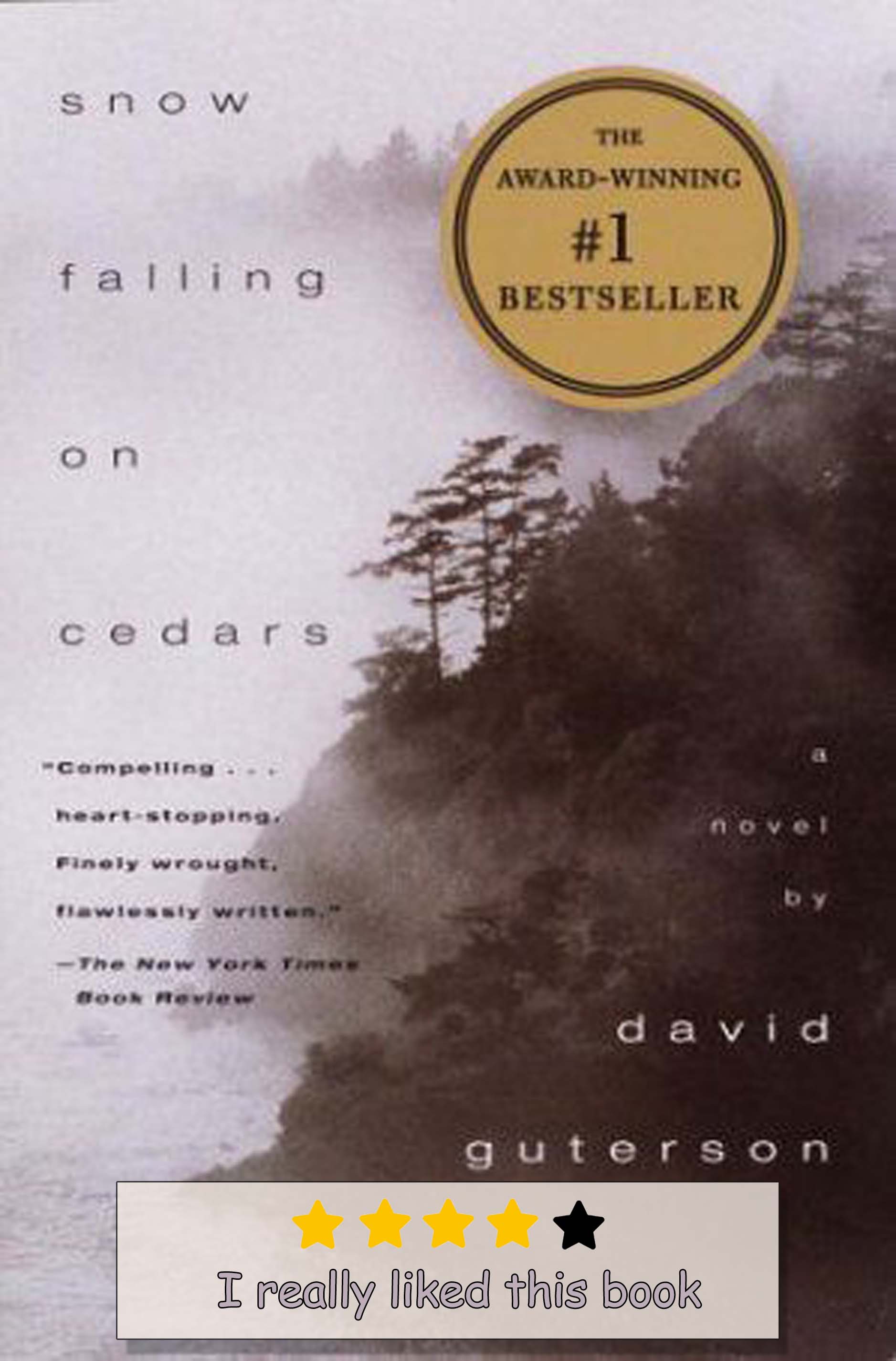
On the small island of San Piedro on the northwest coast of Washington in 1954, a local fisherman, Carl, is found dead, tangled in his own net and drowned. A suspicious wound on his head leads to an investigation into the dead man’s affairs, and before long another local fisherman, Kabuo, is accused of murder. At the back of the courtroom, Kabuo’s wife, Hatsue, anxiously watches the precedings. And somewhere else in the courtroom, the reporter Ishmael watches Hatsue.
Some of the inhabitants of San Piedro are convinced of Kabuo’s guilt and see him as a foreigner and enemy. Others see him as an American who happens to have parents who were born in Japan. Ishmael most of all sees him as the man who ended up marrying the woman Ishmael loves. Ishmael and Hatsue grew up together, but Hatsue gave into her family’s wishes and married Kabuo, and Ishmael joined the army and lost his arm in the war.
The story of Kabuo’s trial as in unfolds on the pages of Snow Falling on Cedars, is a complicated story. It is a story of prejudice and racism, of a war that tore communities apart, of the men who suffered deep trauma from the the war, and the women who had to live with the fact that their husbands and sons came home changed, if they came home at all. It is also a story of the beauty and cruelty of the sea and of island life, and the strange duality of a small, isolated community where people on one hand rely on each other for survival, but on the other keep to themselves and only reluctantly accept outsiders.
Sometimes poetic in its descriptions of the harsh and beautiful nature of San Piedro, sometimes infuriating in its depictions of prejudice, sometimes horrifying in its accounts of the atrocities of the battlefield. Snow Falling on Cedars is much more than a courtroom drama or whodunnit. It is a warning against the terrifying ease of allowing oneself to be ruled by prejudice, and a depiction of the devastating effects of long-lasting trauma suffered from war.
Mystery – Historical fiction
 Mostly Murders
Leave a comment